
This guide draws on biomechanics research published by the FIS (Fédération Internationale de Ski), aerodynamics data from wind tunnel studies conducted at elite national training centers, and publicly available coaching methodology from the Norwegian, Austrian, and German ski jumping programs — three nations that have dominated the sport for decades.
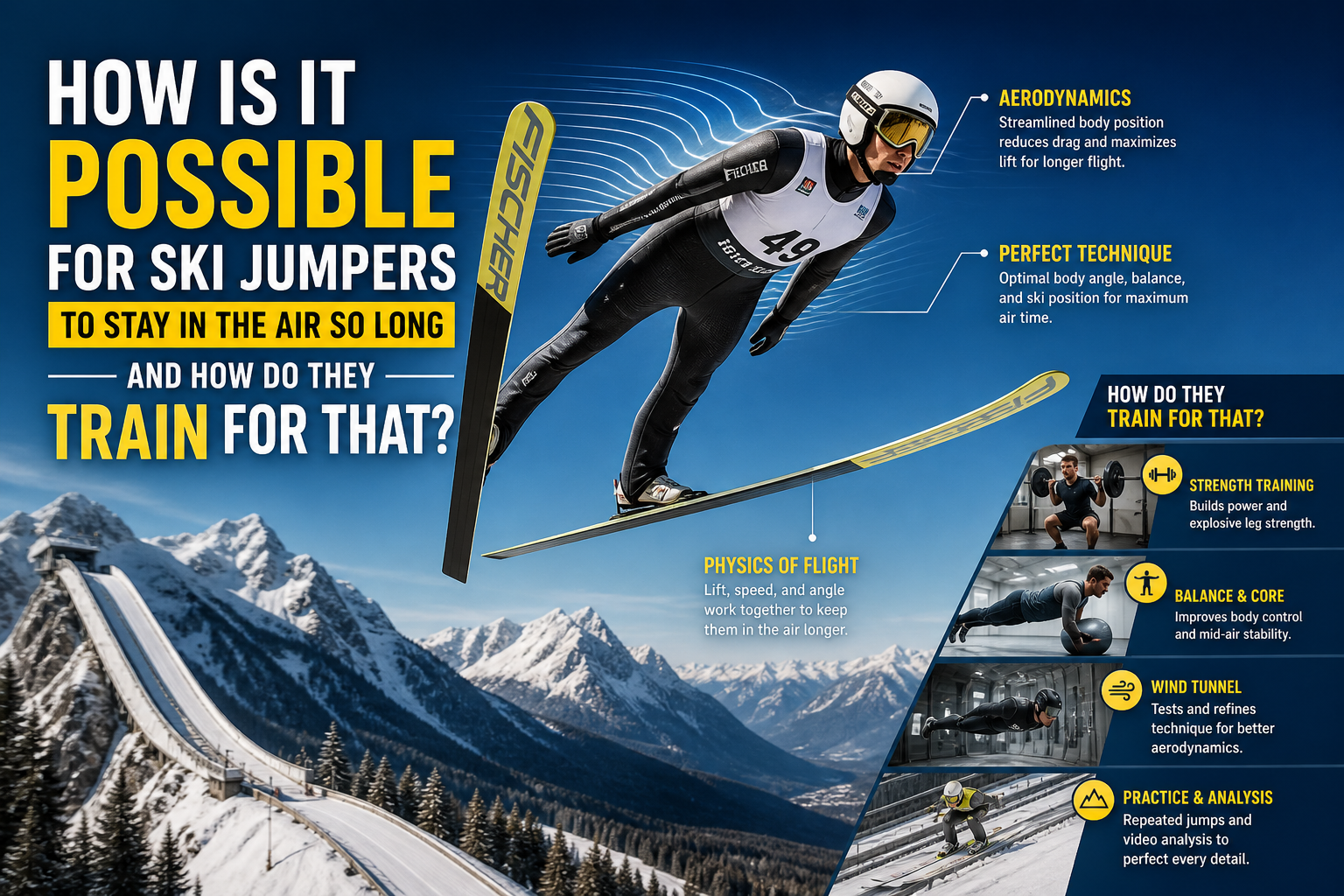
Watch a ski jumper leave the ramp and you’ll immediately ask yourself: how is it possible for ski jumpers to stay in the air so long — and how do they train for that? For six, sometimes seven full seconds, a human being glides through the air, covering distances greater than a football field, before landing with pinpoint precision on a steep snow slope below.
It looks like magic. It is not.
Ski jumping is one of the most scientifically precise sports on the planet. Every fraction of a second in the air is governed by aerodynamics, body mechanics, and physics principles that engineers and physicists study seriously. And behind every breathtaking jump is a decade or more of highly specialized training — in wind tunnels, on plastic summer hills, in gyms, and inside the athlete’s own mind.
In this complete guide, we break down exactly how it is possible for ski jumpers to stay in the air so long — exploring every force at work, every technique that makes the biggest difference, and how they train for that level of aerodynamic mastery.
Quick Answer: Why Don’t They Just Fall?
Ski jumpers stay in the air longer than physics would ordinarily allow because they effectively turn their bodies into a wing. By spreading their skis into a wide V-shape and leaning their torso almost flat against those skis, they generate aerodynamic lift — the same upward force that keeps airplanes aloft.
This lift force acts against gravity and dramatically slows their rate of descent. Instead of plummeting downward like a stone, a well-positioned ski jumper descends at only about 2–3 meters per second vertically while traveling 25+ meters per second horizontally. That ratio is what produces the spectacular soaring effect that makes the sport so mesmerizing to watch.
The short version: speed + body position + aerodynamics = flight. The longer version is far more fascinating.
The Four Forces Acting on a Ski Jumper
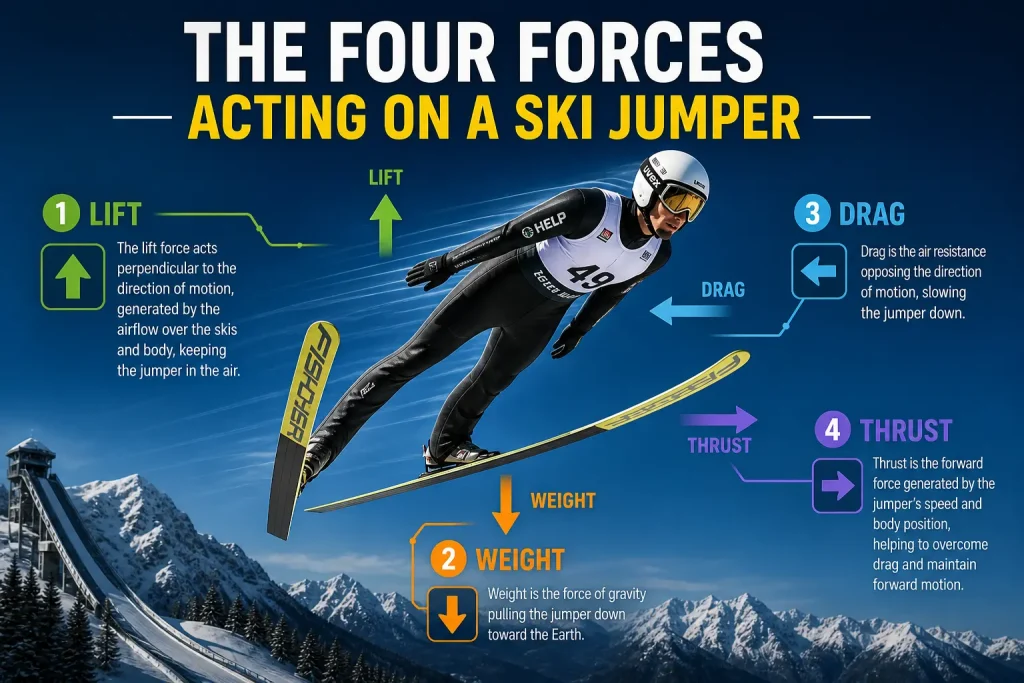
From the moment a ski jumper leaves the takeoff table until they touch down on the slope, four fundamental forces are constantly at work. Understanding these forces is the foundation for understanding everything else.
1. Gravity
Gravity pulls the jumper downward continuously. This force never stops and cannot be eliminated. The entire goal of ski jumping technique is to counteract gravity as efficiently as possible for as long as possible — not to overcome it completely, but to slow its effect dramatically.
2. Lift
Lift is the upward aerodynamic force generated when air flows over and under the jumper’s body. When the body is angled correctly relative to the airflow, high-pressure air builds below while lower-pressure air moves above — and the pressure difference pushes the jumper upward. This is identical in principle to how an airplane wing works. The larger the effective surface area and the better the angle relative to incoming air, the greater the lift produced.
3. Drag
Drag is air resistance — the force that pushes back against the jumper’s forward movement. It’s both a friend and an enemy. Excessive drag slows the jumper down, which reduces lift. But without any drag, the jumper would simply shoot through the air without the controlled deceleration needed for a safe landing. Elite jumpers minimize drag through body position, tight-fitting suits, and careful equipment choices, while accepting a calculated amount of drag to maintain control.
4. Momentum
The kinetic energy built up during the inrun carries the jumper forward through the air. High momentum means more airflow over the body, which means more lift. This is why the inrun speed — often exceeding 90 km/h (56 mph) — is so critically important. Without that momentum, the aerodynamics simply don’t work well enough to produce significant flight.
The interaction between these four forces, shaped by body position and technique, determines every meter of the jump.
How Ski Jumpers Become a Human Airfoil
The term “airfoil” refers to any shape designed to generate lift when moving through air. Airplane wings are airfoils. Helicopter rotors are airfoils. And when a ski jumper adopts the correct flight position, their body and skis together function as one large, remarkably effective airfoil.
Here’s the critical insight: lift is generated by pressure differences. When an airfoil moves through air, the shape causes air to move faster over the top surface than the bottom. Faster-moving air has lower pressure (Bernoulli’s principle), so pressure below the airfoil pushes up. Additionally, the tilt of the airfoil relative to the airflow (called the “angle of attack”) deflects air downward — and by Newton’s third law, the air pushes the airfoil upward with equal force.
A ski jumper’s skis spread in the V-style create the wide, flat surface of this airfoil. The jumper’s torso, pressed forward and down toward the skis, creates the angled surface that interacts with incoming air. The entire athlete becomes the wing. The more precisely this human wing is shaped and angled, the more lift it generates — and the longer the jumper stays in the air.
This is why even minor changes in body position — shifting the hip angle by a few degrees, adjusting arm placement by a few centimeters — can measurably affect flight distance at the elite level.
The Inrun: Why Speed Is Everything
Long before the jump happens, the physics of the flight are already being determined. The inrun — the steep ramp that athletes descend before the takeoff — is where the aerodynamic equation is set up.
During the inrun, jumpers adopt a deep, aerodynamic crouch to minimize wind resistance and build maximum speed. By the time they reach the takeoff table, they are traveling at 85–105 km/h (53–65 mph) depending on the hill size. On the largest “ski flying” hills, speeds can reach close to 110 km/h.
Why does this speed matter so much for flight? Because lift is proportional to the square of velocity. This means doubling the inrun speed doesn’t double the lift — it quadruples it. Even small differences in approach speed translate into meaningful differences in flight distance. A jumper who reaches the takeoff at 95 km/h instead of 90 km/h is not just slightly faster — they’re generating significantly more potential lift.
This is also why weather conditions matter enormously. A slight headwind acts like additional speed for the jumper’s body, increasing effective airflow and lift. A tailwind reduces effective airflow and shortens the jump. Competition organizers monitor wind conditions constantly, and modern scoring systems include wind compensation points to account for these differences.
Inrun Surface, Wax, and the Hidden Variable Most Viewers Miss
While body position and aerodynamics dominate most discussions of ski jumping, there is one performance variable that almost never makes the broadcast commentary — and it can meaningfully affect every jump: the inrun surface and ski wax selection.
Modern ski jumping inruns are built with ceramic-coated tracks and embedded cooling systems that maintain a consistent, controlled surface temperature regardless of weather conditions. This engineering ensures that inrun speed is determined by the athlete’s technique and starting position — not by random surface variation. Without this, a warm sunny day would produce dramatically slower inrun speeds than a cold evening, making fair competition impossible.
Ski wax selection adds another layer of precision. Before every competition, technicians apply hot wax to the base of the jumper’s skis — but the specific wax compound used depends entirely on the day’s conditions. Snow temperature, air temperature, humidity, and inrun surface type all influence which wax formulation minimizes friction most effectively. A wax that performs optimally at −5°C can actually increase friction at −15°C, producing a measurably slower inrun and a shorter jump. At the World Cup level, where the difference between a podium finish and fourth place can be a single meter, wax selection is taken extremely seriously — dedicated wax technicians work with national teams specifically for this purpose.
For training facilities without snow, most major centers now use plastic-matted inruns treated with water and lubricants that replicate the friction profile of snow as closely as possible. Athletes training year-round on these surfaces develop inrun technique that transfers almost identically to winter competition conditions.
The Takeoff: The Most Important Half-Second in Sport
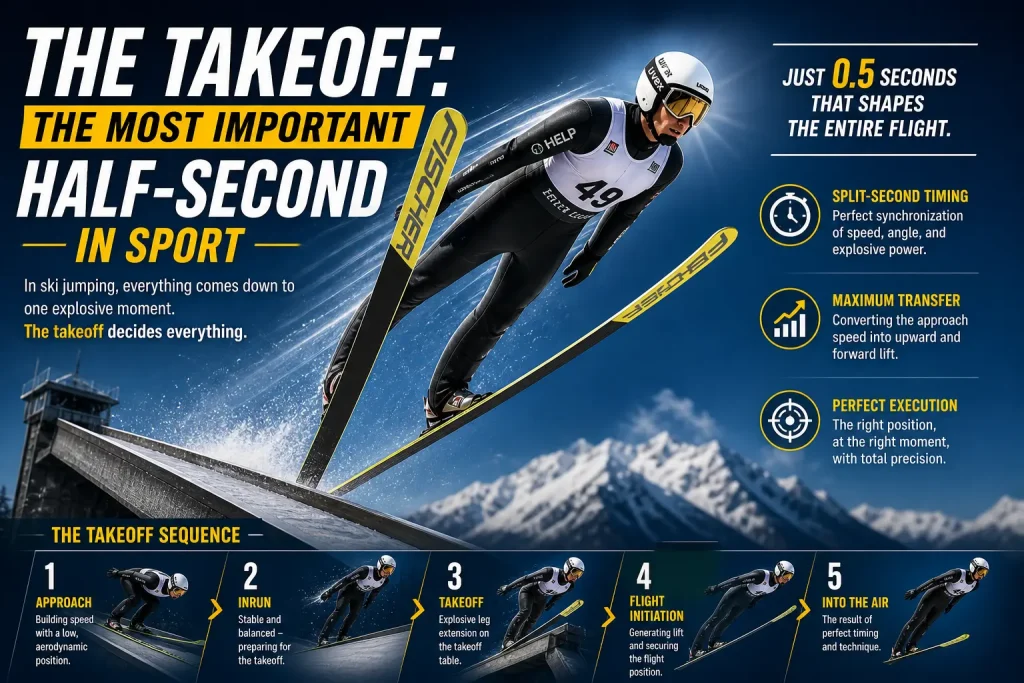
At the end of the inrun, there is a flat or slightly upward-angled section called the takeoff table. Here, in approximately 0.25 to 0.30 seconds, the athlete executes one of the most technically demanding movements in all of sport.
The takeoff is the moment when forward speed is converted into upward and forward momentum. Done correctly, it gives the jumper the ideal trajectory to maximize flight. Done poorly — even slightly — it can mean a short jump, an unstable flight, or worse.
What makes a perfect takeoff?
- Timing: The extension must begin at the precise moment the skis reach the edge of the table. Too early and the jumper “tops out” before the end, losing energy into the ground. Too late and the takeoff force isn’t fully translated into flight.
- Full-body extension: The jumper explodes upward through the ankles, knees, and hips simultaneously. The extension must be powerful and complete — a partial or hesitant extension loses significant distance.
- Forward lean initiation: At the same moment as the leg extension, the jumper must begin leaning their torso forward into the flight position. This transition must be smooth — too fast and they tumble; too slow and they waste valuable airtime in a suboptimal posture.
- Stability: Any sideways wobble, any imbalance in the extension, gets dramatically amplified in the air. The takeoff must be symmetrical and controlled.
Top ski jumping coaches describe the perfect takeoff as an “explosive release” — maximum power combined with maximum precision, in less time than it takes to blink twice. It is practiced thousands of times per season.
The V-Style Revolution That Changed Everything
If you want to understand how modern ski jumpers fly so far, you have to understand the V-style — the single most important technical innovation in the sport’s history.
Before the late 1980s, ski jumpers held their skis parallel during flight, tips together, forming a narrow forward-pointing profile. This technique was effective, but it left enormous aerodynamic potential untapped.
Then came Swedish jumper Jan Boklöv. Beginning in 1985, he began experimenting with spreading his ski tips outward into a V-shape during flight. The skiing establishment was skeptical — judges even penalized him with lower style scores because the technique looked unconventional. But the numbers told a different story.
The V-style generates approximately 28% more lift than the parallel technique. Here’s why:
- Greater surface area: Spread skis create a much wider “wing” that catches more air across a larger area, producing significantly more lift force.
- Better angle of attack: The V-shape allows each ski to be angled optimally to the incoming airflow, maximizing pressure difference above and below.
- Integrated body-ski surface: With the body pressed forward between the V, the jumper’s torso becomes part of the continuous lifting surface — from ski tip, across the body, to the other ski tip. This creates a single large airfoil rather than a narrow one.
- Natural stability: The V-shape, like the spread wings of a gliding bird, provides inherent lateral stability that makes controlling the flight position easier.
Despite initial resistance, Boklöv won the 1988–89 World Cup overall title, and the aerodynamic advantage was impossible to ignore. By the early 1990s, every competitive ski jumper in the world had adopted the V-style. It has been universal ever since, with refinements continuing to this day.
Today’s elite jumpers fine-tune the exact V-angle — typically 30–35 degrees per ski from the center line — based on wind conditions, hill size, and personal physiology. This optimization is one of the areas where modern wind tunnel training has been most valuable.
Body Position During Flight: Every Centimeter Counts
Once airborne, ski jumpers must maintain one of the most aerodynamically demanding body positions in competitive sport — and hold it while resisting powerful air forces for up to seven seconds.
Forward Lean Angle
The torso is angled forward at roughly 45–50 degrees from horizontal. This nearly parallel-to-the-skis position creates the flat aerodynamic surface needed for lift. Too upright and there isn’t enough surface area to generate meaningful lift. Too flat and the jumper risks instability or loss of control. Finding and holding the optimal angle is one of the core skills developed over years of training.
Arm Position
Arms are pressed tightly against the body, often running back alongside the hips, with hands near or touching the thighs. Extended arms would create significant turbulence and drag. Elite jumpers keep their arm position so disciplined that it barely changes throughout the entire flight phase.
Head and Neck
The chin is tucked down and forward, with the helmet’s smooth surface facing into the airflow. Looking up creates a “sail” effect that disrupts airflow over the back, increasing drag. Looking down too far changes the body’s angle of attack unfavorably. The head position is precise and practiced.
Ski Spread and Angle
The V-angle itself is actively managed throughout the flight — opened wider when more lift is needed, narrowed slightly when the jumper needs to control speed on descent toward the hill. This micro-adjustment, invisible to casual observers, is a hallmark of elite technique.
Hip Position
Hip angle is perhaps the most nuanced element of flight position. A slightly higher hip angle increases the body’s angle of attack, generating more lift at the cost of more drag. Coaches and athletes spend enormous amounts of time optimizing this trade-off for specific conditions.
How Wind Can Help or Destroy a Jump
Wind is one of the most significant external variables in ski jumping — powerful enough to add or subtract 15–20 meters from an otherwise identical jump.
Headwind (blowing into the jumper’s face) acts like additional airspeed. It increases the effective airflow over the jumper’s body, generating more lift without requiring higher inrun speed. A moderate headwind of 3–4 m/s can meaningfully extend flight distance. Strong headwinds, however, can make flight unstable and difficult to control.
Tailwind (blowing from behind) reduces effective airflow, generating less lift and typically shortening the jump. It also makes it harder for the jumper to maintain the forward-lean flight position, since less air is pushing against the body.
Side wind is the most dangerous. It can push a jumper laterally off the ideal flight path, requiring constant correction that wastes energy and disrupts the aerodynamic position.
To maintain competitive fairness, the FIS (Fédération Internationale de Ski) uses a wind compensation point system in official competitions. Every competition has sensors measuring wind speed and direction at multiple points on the hill. Points are added or subtracted from scores based on recorded wind conditions — ensuring that jumpers aren’t unfairly penalized for a tailwind or inappropriately rewarded for a tailwind. The calculation formulas are specific to each hill and updated regularly.
Competition organizers also have the authority to delay or halt jumping when winds become too dangerous — a crucial safety measure on hills where athletes reach 100 km/h.
Why the Landing Hill Is Engineered to Match the Flight
One of the most ingenious aspects of ski jumping is the hill design itself — and it’s something that makes the sport far safer than it might appear.
A ski jumping hill is not a random slope. It is precisely engineered so that the landing surface curves away from horizontal at roughly the same rate that the jumper descends through the air. The result: when the jumper touches down, the relative vertical difference between their trajectory and the slope surface is only about 1–3 meters — similar to jumping off a table.
This means that despite soaring 100+ meters through the air from a 90-meter hill (or 120+ meters from a “large hill”), the actual landing impact is relatively controlled. The slope absorbs the downward component of the motion, while the forward momentum continues naturally down the hill.
Key reference points on every ski jumping hill:
- K-Point (Kritischer Punkt / Critical Point): The engineered target distance where the hill begins to flatten. Landing at or near the K-point earns the baseline distance score. The hill is specifically designed so that K-point landings are safe and controlled.
- Hill Size (HS): The maximum safe landing distance on the hill. Jumping beyond the HS is technically possible but increasingly risky as the slope flattens further. Record attempts and “ski flying” events use specially designed hills with extended HS values.
- Knoll (Transition Zone): The area below the K-point where the slope transitions to a gentler gradient. Landing here after an extraordinary jump requires careful technique to manage the additional impact forces.
The Telemark Landing and Why It Matters
Once a jumper approaches the slope, they must transition from the aerodynamic flight position to a stable landing — all while still traveling at considerable speed.
The standard landing technique in competitive ski jumping is the Telemark landing, named after the Norwegian region where ski jumping originated. In a Telemark landing, one ski touches down slightly ahead of the other, the knees are bent and separated, the arms spread outward for balance, and the body absorbs the impact in a controlled, diagonal stance.
The Telemark is rewarded by judges for several reasons:
- Stability: The staggered foot position provides a larger, more stable base for absorbing landing forces than a two-footed landing.
- Control: Bending into the Telemark position with arms spread demonstrates the jumper had full control throughout the flight — not just surviving the jump but mastering it.
- Shock absorption: The bent-knee, staggered-foot position distributes landing forces across a longer distance, reducing peak impact on joints.
- Style points: In the FIS scoring system, each judge can award up to 20 points for style, and a clean Telemark landing is one of the most heavily weighted components of the style score.
A two-footed landing, a fall, or a stumble all result in style point deductions — and at the elite level, style scores can determine podium positions.
Physical Training: Building the Body of a Ski Jumper
The body of an elite ski jumper is highly specialized. They are not the largest or strongest athletes in winter sport — in fact, the FIS enforces strict body-mass-index (BMI) rules to prevent dangerous weight loss — but they have developed a precise combination of explosive power, core stability, flexibility, and body awareness that few other disciplines require.
Explosive Lower-Body Power
The takeoff requires maximum leg power delivered in 0.25 seconds. Training focuses on developing the fast-twitch muscle fiber explosiveness needed for this:
- Barbell squats and jump squats
- Romanian deadlifts for posterior chain development
- Bulgarian split squats for single-leg strength and hip stability
- Step-ups with explosive drive
- Heavy calf raises for ankle extension power
Plyometric Training
Plyometrics bridge the gap between raw strength and explosive speed. A ski jumper who can squat 200 kg but can’t apply that strength in 0.25 seconds is less useful than one who can squat 130 kg with elite explosive velocity.
- Depth jumps (stepping off a box and immediately jumping as high as possible)
- Box jumps with maximum height emphasis
- Bounding exercises for horizontal power development
- Single-leg hops for lateral stability and proprioception
- Continuous hurdle jumps for reactive strength
Core Stability and Anti-Rotation Strength
Holding the flight position against powerful airflow requires extraordinary core stability. The core must resist not just gravity but the constantly shifting aerodynamic forces trying to disrupt the jumper’s position.
- Long-duration planks (front and side) with positional holds mimicking flight posture
- Hanging leg raises for hip flexor and abdominal strength
- Anti-rotation press exercises (Pallof press)
- Stability ball exercises for dynamic core control
- Supine hollowing drills to train the deep stabilizing muscles
Flexibility and Mobility
The extreme forward-lean flight position requires exceptional hip flexor flexibility and thoracic (upper back) mobility. Without this flexibility, athletes cannot achieve the aerodynamic position regardless of how strong they are.
- Daily hip flexor stretching protocols
- Thoracic spine mobilization exercises
- Hamstring flexibility work (tight hamstrings prevent the deep forward lean)
- Shoulder and chest opening stretches
Balance and Proprioception
The ability to sense the body’s position in space and make instant micro-corrections is fundamental to ski jumping.
- Balance board and rocker board training
- Slackline walking for dynamic balance development
- Single-leg stance exercises on unstable surfaces
- Bosu ball drills with sport-specific movement patterns
BMI Rules and Body Composition
Since lighter athletes get proportionally more aerodynamic benefit from longer skis (ski length is capped at 145% of body height), there was historically pressure for jumpers to maintain dangerously low body weights. The FIS now enforces a minimum BMI rule: jumpers with BMI below 20.5 have their maximum ski length reduced, eliminating the aerodynamic advantage of extreme thinness and protecting athlete health.
Technical Training: Wind Tunnels, Plastic Hills & Video Analysis
Physical fitness alone does not make a ski jumper. The technical and aerodynamic education required is just as demanding — and uses some of the most sophisticated sports science tools available.
Wind Tunnel Training
Vertical wind tunnels allow athletes to practice the flight position under controlled airflow without leaving the ground. Jumpers can experiment with micro-adjustments to V-angle, hip position, arm placement, and head angle while coaches measure lift and drag forces in real time. The immediate feedback loop that wind tunnels provide — impossible during actual jumps — accelerates technique development significantly. Most national team programs include regular wind tunnel sessions throughout the training year.
Plastic (Artificial) Summer Hills
Ski jumping does not stop when winter ends. Most major training facilities have artificial hill surfaces — typically a special plastic matting — that allow year-round training jumps. These plastic hills replicate the inrun and flight phase almost identically to snow conditions; only the landing surface feels different. Athletes can accumulate hundreds or even thousands of training jumps per year across all seasons, building the repetition base needed to develop and maintain elite technique.
Video Analysis and Biomechanics
Every training jump at the elite level is recorded from multiple angles — usually at least side-on, front-on, and from the landing hill looking up. Coaches use slow-motion analysis to examine:
- Takeoff timing (the window is 0.25–0.30 seconds; too early or late is visible in slow motion)
- Transition speed into flight position
- V-angle consistency across the flight phase
- Hip and torso angle at different points in the flight
- Arm position and any turbulence-inducing movements
- Landing technique and Telemark quality
Advanced systems can overlay aerodynamic modeling data onto video footage, showing coaches and athletes exactly where lift and drag are changing — and why. This data-driven feedback has transformed elite ski jumping coaching over the past two decades.
Trampoline and Acrobatic Training
Many junior programs incorporate trampoline training and basic gymnastics to develop the body awareness and spatial orientation that translates directly to managing the flight phase. Learning to control body position while airborne — even in a completely different context — builds the proprioceptive foundation that ski jumping demands.
Mental Training: Controlling the Mind at the Top of the Hill
At some point in every ski jumper’s career, they stand at the top of a 90-meter or 120-meter hill — a structure as tall as a 10-story building — knowing they are about to launch themselves off it at nearly 100 km/h. The physical training prepares the body. The mental training prepares everything else.
Visualization
Visualization — mentally rehearsing the entire jump in vivid, detailed, first-person imagery — is one of the most widely used and well-documented performance psychology techniques in ski jumping. Athletes will run through their jump mentally dozens of times before competition: the inrun crouch, the timing of the takeoff, the sensation of leaving the table, the flight position, the landing. Research consistently shows that high-quality mental rehearsal activates many of the same neural pathways as physical practice.
Pre-Jump Routine
Elite jumpers develop consistent pre-jump routines — specific sequences of physical actions, breathing patterns, and mental cues performed before every jump. These routines serve to focus attention, reduce anxiety, and cue the body into the performance state. The consistency of the routine itself is part of its value: it signals to the nervous system that what comes next is practiced, familiar, and manageable.
Breathing and Arousal Control
Managing the body’s stress response is critical. Too much adrenaline causes muscular tension and disrupts the fine motor control needed for takeoff timing. Specific breathing techniques — typically slower, deeper breathing in the seconds before the jump — activate the parasympathetic nervous system, reducing heart rate and muscle tension to optimal levels.
Focus and Process Orientation
Sport psychologists working with ski jumpers emphasize process focus over outcome focus — thinking about the execution (timing, body position, takeoff extension) rather than the result (distance, score, placement). Jumpers who focus on the process rather than the outcome perform more consistently under competitive pressure.
Equipment Rules and Their Impact on Flight
Ski jumping equipment is heavily regulated by the FIS to ensure that competition is decided by athlete skill, not equipment advantage. Understanding these rules helps explain why jumpers look and perform the way they do.
Skis
Ski length is capped at 145% of the jumper’s body height. For a 180 cm athlete, maximum ski length is 261 cm. This rule creates an interesting dynamic where taller athletes get longer skis — and thus more lift surface. Skis must also meet specific width and binding placement requirements. They are typically wide and flat with a slight upward curve at the tip, optimized for lift rather than edge performance.
Suits
Suit regulations are among the most detailed in any sport. The FIS specifies allowed fabrics, maximum thickness, and air permeability requirements. Suits cannot be too baggy (which would generate excessive “sail” lift that the jumper hasn’t earned through technique) or have internal structures that artificially maintain body position. Every suit used in World Cup or Olympic competition is measured and tested before competition.
When Suit Rules Become a Competitive Battleground
FIS suit regulations exist for good reason — and the history of competitive ski jumping includes several high-profile incidents that illustrate exactly why these rules matter so much.
Research published in Frontiers in Sports and Active Living found that adding just one centimeter to the overall circumference of a ski jumping suit increases jump distance by approximately 3.2 meters. A separate study suggested that a single centimeter of extra fabric at the crotch area alone could add up to four meters of distance. At the elite level, where competitions are decided by fractions of a meter, this is not a minor advantage — it is potentially the difference between a gold medal and no medal at all.
In January 2026, several officials from Norway’s national ski jumping team were temporarily banned from competition after officials discovered they had altered athletes’ suits with extra crotch stitching at the Nordic World Ski Championships — a scandal that became widely known as “Penisgate” after the measurement method used to detect the alteration. The incident was significant not just as a rules violation but as a demonstration of how sophisticated and high-stakes suit optimization has become at the top level of the sport.
At every World Cup and Olympic competition, suits are measured by laser and checked physically before athletes are permitted to jump. The FIS employs specific measurement protocols — including crotch height measurements — to verify compliance. Five athletes were disqualified from the 2022 Winter Olympics in Beijing specifically because their suits were found to be non-compliant with permeability and fit regulations. The scrutiny applied to ski jumping suits is arguably more rigorous than equipment checks in any other winter sport.
The reason this level of regulation is necessary comes back to the fundamental aerodynamics of the sport: any additional fabric surface area creates additional lift. A slightly baggy suit acts like a parachute or a flying squirrel’s membrane — generating lift the athlete has not earned through technique. Controlling suit specifications is the only way to ensure that distance reflects athletic skill, not tailoring.
Helmets and Boots
Helmets must meet safety standards while being as aerodynamically smooth as possible. Boots are specifically designed for ski jumping — they allow extreme forward lean (the ankle joint must flex forward significantly more than in any other ski sport) while providing the stability needed for the explosive takeoff push.
World Records and What Makes an Elite Jump
To put the physics and training into perspective, consider the numbers at the absolute pinnacle of the sport:
- World Record (Ski Flying): Stefan Kraft (Austria) holds the official individual ski flying record at 253.5 meters set in Vikersund, Norway in 2017.
- Olympic Large Hill: Competitions are held on hills with a K-point typically around 120 meters (HS 130–140 m). Top competitors regularly clear the K-point.
- Normal Hill: Olympic normal hill competitions use hills with K-points around 90–95 meters.
- Flight time: On large hills, elite jumpers spend approximately 5–7 seconds in the air. On ski flying hills, this can extend beyond 7 seconds.
- Inrun speed: Up to 105–110 km/h on ski flying hills.
What separates world-class jumpers from merely excellent ones? At the highest level, the differences come down to:
- Takeoff timing precision (measured in hundredths of a second)
- Consistency of V-angle throughout the full flight
- Hip and torso angle optimization in the first two seconds of flight
- Mental composure under competition pressure
- Physical readiness across an entire season (peaking at the right moment)
Frequently Asked Questions
How long are ski jumpers actually in the air?
On a standard Olympic large hill (HS 130 m), elite ski jumpers are typically airborne for 5–7 seconds. On the largest ski flying hills (HS 240+ m), flight time can exceed 7 seconds.
Why do ski jumpers lean so far forward?
The extreme forward lean — nearly parallel to the skis — is essential for creating the flat aerodynamic surface that generates lift. A more upright position would reduce the effective lift surface dramatically and shorten the jump. The angle is approximately 45–50 degrees from horizontal.
Does being lighter make you a better ski jumper?
Lighter athletes generate more lift relative to their body weight (better lift-to-weight ratio). However, the FIS’s BMI rule (minimum 20.5 BMI, or reduced ski length) ensures that extreme thinness is not rewarded. The ideal ski jumping physique is lean, powerful, and tall — with low weight achieved through natural athleticism, not unhealthy restriction.
What force do ski jumpers most want to maximize?
Lift. Maximizing aerodynamic lift while minimizing drag is the central technical challenge of ski jumping. Lift counteracts gravity and extends flight time; drag slows forward momentum and reduces the airflow that generates lift.
How do ski jumpers practice in summer with no snow?
Most elite training centers have artificial plastic hills that replicate snow conditions for the inrun and takeoff. Athletes also use wind tunnels for body position training, and gymnastic or trampoline training for developing body awareness. Summer training volume can match or exceed winter training volume.
Is ski jumping dangerous?
Like all high-speed gravity sports, ski jumping carries risk. However, modern hill engineering (designed so landing impact equals roughly jumping off a table), improved safety equipment, strict technique training, and competition management (halting when winds are dangerous) have made the sport significantly safer than it was in earlier decades. Most injuries occur during falls — often from unstable takeoffs or wind gusts — rather than from normal landings.
What is the K-point in ski jumping?
The K-point (Kritischer Punkt, or “critical point”) is the engineered reference distance on a ski jumping hill where the slope begins to flatten. It serves as the baseline distance for scoring calculations. Jumping to the K-point earns a base number of distance points; jumps beyond add points, jumps short subtract them.
Who invented the V-style technique?
Swedish jumper Jan Boklöv pioneered the V-style in the mid-1980s. Despite initial skepticism from judges and the establishment, the aerodynamic advantage was undeniable — he won the 1988–89 World Cup overall, and the technique became universal in professional ski jumping by the early 1990s.
Conclusion
Ski jumping is a sport that sits at the intersection of applied physics, human athleticism, and extraordinary mental discipline. When you watch a jumper leave the ramp and soar through the air for six or seven breathtaking seconds, you are watching the product of aerodynamic principles used with precision, years of physical conditioning, thousands of training repetitions, and a mindset forged on some of the most intimidating starting gates in sport.
They stay in the air so long because they have become, in the most literal sense, a flying machine — a carefully shaped, finely tuned human airfoil that turns speed into lift, gravity into distance, and training into those few perfect seconds of flight.
And every one of those seconds is earned.
You May Also Like It:
Basic Coding Concepts – Beginners Guide
Simple Coding Projects for Beginners
Huffman Coding – The Core of Data Compression Explained
