
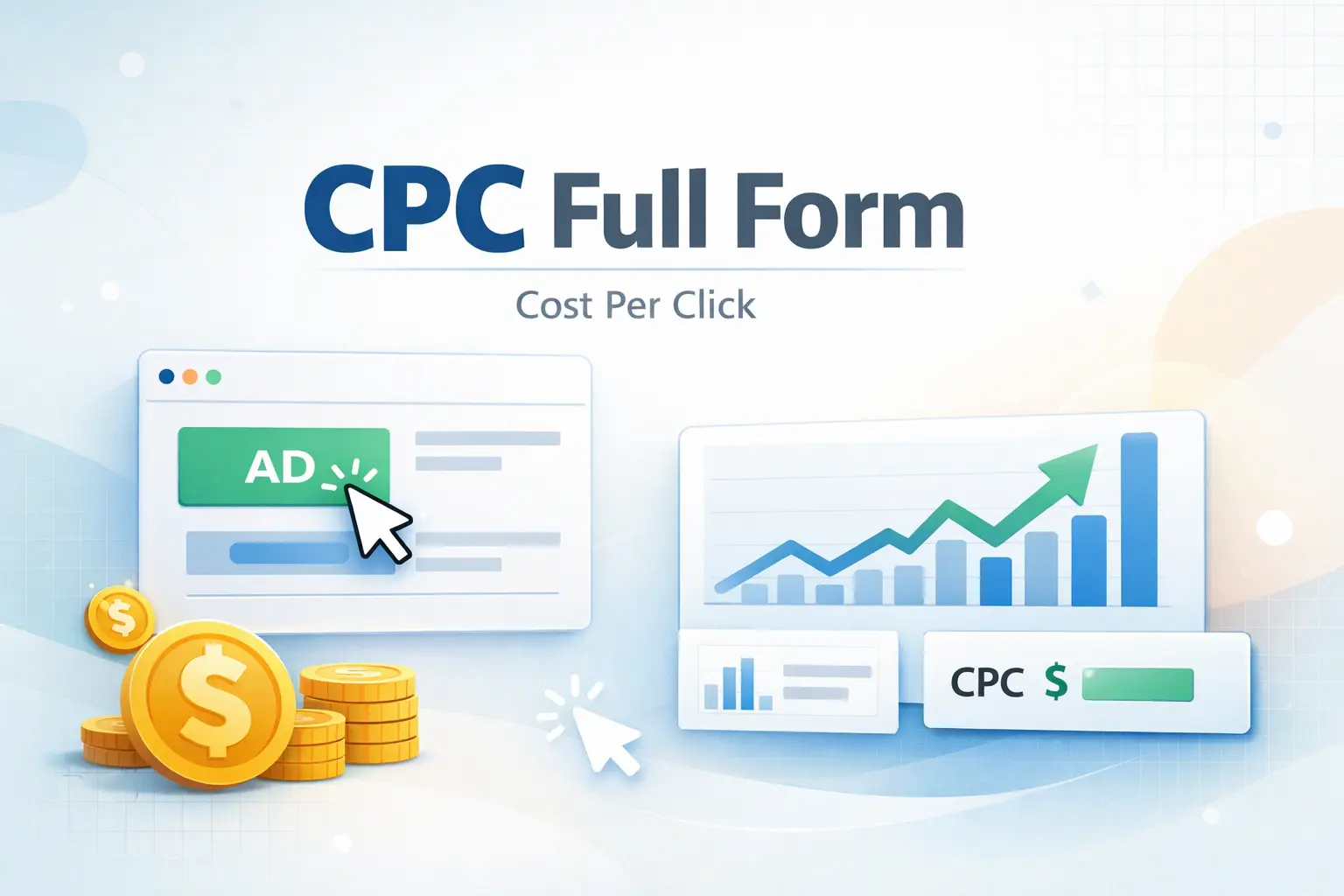
The CPC full form is Cost Per Click.
CPC is one of the most common and important terms in SEO, digital marketing, and online advertising. If you run ads, manage websites, or work with Google Ads, understanding CPC is essential.
Let’s break it down step by step in a simple way.
What Does CPC (Cost Per Click) Mean?
Cost Per Click (CPC) is the amount of money an advertiser pays each time someone clicks on their ad.
In simple words:
You pay only when a user clicks on your advertisement.
Example:
- CPC = $0.50
- 100 clicks = $50 total cost
Why CPC Is Important in SEO & Digital Marketing
CPC helps marketers understand:
- How competitive a keyword is
- How much it may cost to get traffic
- Whether paid ads are profitable or not
High CPC usually means:
- Strong buying intent
- High competition
- More advertisers bidding on the keyword
Low CPC usually means:
- Less competition
- Informational or low-intent keywords
CPC in SEO vs CPC in Paid Advertising
Many beginners confuse SEO and CPC. Let’s clear it up.
CPC in SEO
In SEO, CPC is used mainly for:
- Keyword research
- Understanding keyword value
- Estimating earning potential (Adsense / affiliate)
You don’t pay for clicks in SEO, but CPC tells you how valuable a keyword is.
CPC in Paid Ads (PPC)
In PPC (Pay Per Click) platforms like:
- Google Ads
- Bing Ads
- Facebook Ads
You pay money per click, and that cost is your CPC.
How CPC Is Calculated
The basic formula is:
- CPC = Total Ad Cost ÷ Total Clicks
Example:
- Total ad spend = $200
- Total clicks = 400
- CPC = $200 ÷ 400 = $0.50
What Is a Good CPC?
There is no fixed “best” CPC. It depends on:
- Industry
- Country
- Keyword intent
- Conversion value
General idea:
- Low CPC: $0.01 – $0.30
- Medium CPC: $0.30 – $1.50
- High CPC: $2+ (finance, insurance, software)
Finance and insurance keywords often have very high CPC because one conversion can be worth hundreds of dollars.
Factors That Affect CPC
Several factors decide how high or low CPC will be:
Keyword Competition
- More advertisers = higher CPC
Search Intent
- Buyer-intent keywords usually cost more
Example:
- “What is SEO” → Low CPC
- “Buy SEO services” → High CPC
Industry Type
- Finance, legal, SaaS, and health niches usually have higher CPC.
Location
- CPC varies by country.
- US, UK, Canada → High CPC
- India, Pakistan → Lower CPC
Quality Score (Google Ads)
- Better ad relevance and landing pages can reduce CPC.
CPC vs CPM vs CPA (Quick Comparison)
| Term | Full Form | Meaning |
|---|---|---|
| CPC | Cost Per Click | Pay per ad click |
| CPM | Cost Per Mille | Pay per 1000 impressions |
| CPA | Cost Per Action | Pay per conversion |
Each model is used for different marketing goals.
How CPC Helps in Keyword Research (SEO)
When doing SEO keyword research, CPC helps you:
- Choose profitable keywords
- Find high-value topics
- Estimate AdSense or affiliate income
A keyword with:
- Good search volume
- Medium difficulty
- High CPC
is usually a great SEO opportunity.
Is Higher CPC Always Better?
Not always.
High CPC means high value, but:
- Competition may be tough
- Ranking may take longer
Low or medium CPC keywords are often:
- Easier to rank
- Better for beginners
- Useful for traffic growth
A balanced strategy works best.
CPC Full Form – Final Summary
CPC full form is Cost Per Click
- It shows how much advertisers pay for each click
- CPC is crucial for SEO, PPC, and keyword research
- High CPC = high commercial value
- SEO uses CPC for research, not payment
If you’re learning SEO or digital marketing, CPC is one of the first terms you should master.
