
If you have been wondering how to move to Japan, you are far from alone. Japan consistently ranks as one of the most desirable countries for expats worldwide, and for good reason. It blends an ultra-modern lifestyle with centuries of rich tradition, offers one of the lowest crime rates in the world, and boasts a public infrastructure so reliable it can make the rest of the world look disorganized. But moving to Japan as a foreigner is not as simple as booking a flight. You need a visa, a plan, and a solid understanding of how life in Japan actually works.
This guide walks you through every stage of the process, from choosing the right visa category and applying for a Japan work visa, to finding housing, managing your finances, and eventually working toward Japan permanent residency. Whether you are a skilled professional, a fresh graduate, a remote worker, or someone bringing the whole family, this is the guide you need.
Is Moving to Japan Right for You? Key Facts to Know First
Before diving into paperwork, it helps to understand what living in Japan actually involves day-to-day. Japan is not just a tourist destination. It is a country with deeply ingrained social norms, a demanding work culture in some sectors, and a language that takes real commitment to learn. At the same time, it offers quality of life, safety, and cultural richness that few countries can match.
What Makes Japan Attractive for Expats
- One of the lowest crime rates in the developed world
- Exceptional public transportation, even in smaller cities
- Universal healthcare coverage once you register as a resident
- A booming job market in tech, engineering, and education sectors
- Rich food culture with extremely affordable dining options
- Strong sense of community and neighborhood safety
Honest Challenges You Should Prepare For
- The Japanese language barrier is real and affects daily life significantly
- The rental market can be difficult for foreigners without a Japanese guarantor
- Cultural adaptation takes time, especially around workplace etiquette
- The visa process requires advance planning of several months
- Some rural areas have very limited English-language services
Japan Visa Types: Choosing the Right Path
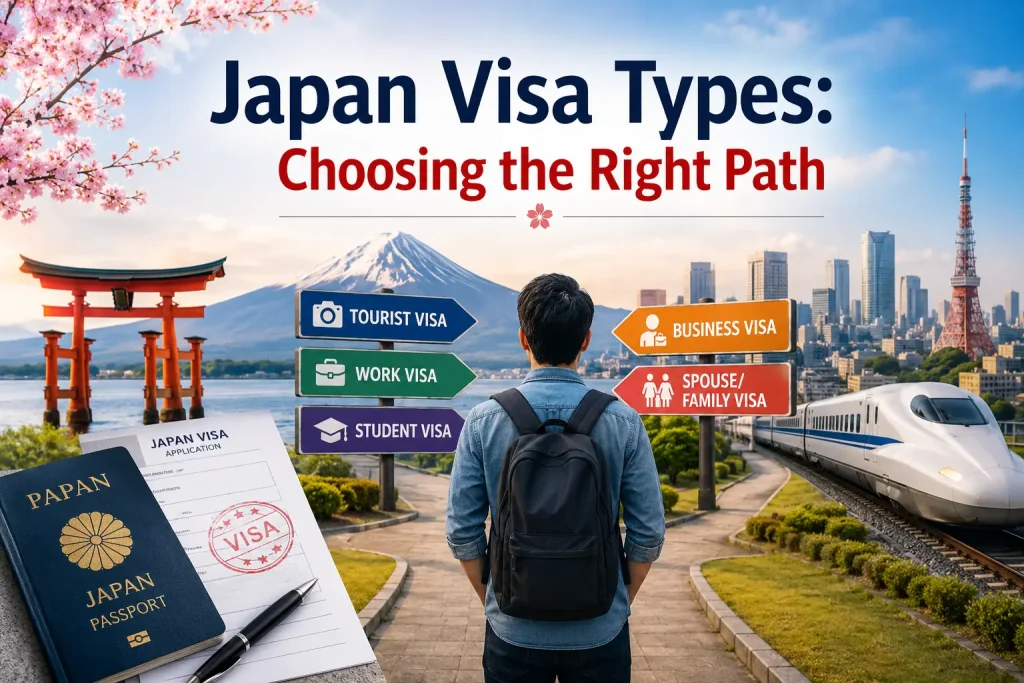
Japan offers a wide range of visa categories for foreign nationals. Which visa you apply for depends entirely on your purpose, qualifications, and circumstances. This section breaks down the main options so you can identify the best route before starting your application.
Japan Work Visa: The Most Common Route for Professionals
The Japan work visa is an umbrella term for several specific categories tied to your industry and skill set. Unlike tourist visas, these allow you to live and legally work in Japan long-term. You cannot apply for a work visa independently. You need a Japanese employer to act as your sponsor, and the process begins with them filing for a Certificate of Eligibility (COE) on your behalf.
The most widely issued work visa in Japan is the Engineer / Specialist in Humanities / International Services visa, commonly known as the Gijutsu / Jinbunkoku visa. This covers professionals in:
- Software engineering and IT
- Business development and marketing
- English teaching and translation
- Finance and accounting
- Architecture and design
To qualify, you generally need a four-year bachelor’s degree in a related field, or at least ten years of professional experience. Your degree does not need to match your job title exactly, but immigration officers will look for a logical connection.
Work Visa Japan Duration and Renewal
Work visas in Japan are typically issued for three months, one year, three years, or five years, depending on your employer’s track record with immigration and your own profile. First-time applicants usually receive a one-year visa. After that, renewals happen from within Japan and do not require a new COE. Importantly, if you lose your job while on a work visa, your visa does not immediately expire. You have up to three months to find new employment before your status is affected.
Highly Skilled Professional Visa (HSP)
Japan introduced a points-based system for high-skilled foreign workers that operates separately from standard work visas. If you score 70 points or more on Japan’s Highly Skilled Professional scoring matrix, you qualify for an HSP visa. The scoring considers factors like your academic background, annual salary, age, and whether you hold Japanese-language qualifications.
The HSP visa comes with significant benefits that standard work visa holders do not receive:
- Permission to engage in multiple job activities simultaneously
- The ability to bring a parent to Japan under certain conditions
- A fast-track route to permanent residency, which can be as short as one or three years depending on your score
- Fewer restrictions on side businesses
Specified Skilled Worker Visa (SSW)
Launched in 2019 to address labor shortages in specific industries, the Specified Skilled Worker program currently covers fourteen sectors including construction, food manufacturing, agriculture, nursing care, hospitality, automobile repair, and industrial machinery. Unlike most work visas, this one does not require a university degree. Instead, you must pass industry-specific skills tests and, in some categories, Japanese language tests.
There are two tiers: SSW Type 1 allows up to five years of work without family reunification rights. SSW Type 2 allows indefinite stay and family reunification, but is only available in certain sectors and requires more advanced skills.
Working Holiday Visa
Japan has bilateral working holiday agreements with 32 countries and regions as of 2026. Eligible citizens aged 18 to 30 (18 to 25 for some countries) can live and work in Japan for up to 12 months. This visa generally requires proof of sufficient funds, often around USD 2,500 to USD 4,000 depending on the applicant’s nationality, along with proof of a return ticket or enough money to purchase one..
The working holiday visa is popular as a stepping stone. Many people use it to gain Japanese work experience, build local connections, and then transition to a formal work visa without leaving Japan.
Student Visa
If you want to study the Japanese language or enroll in a university program, a student visa is your path. Japan’s immigration office requires you to demonstrate strong financial standing: typically around 2 million yen in savings (or equivalent) to cover the first year of living expenses, separate from tuition. A sponsor such as a parent or sibling can fulfill this requirement if you cannot. Students may work up to 28 hours per week with a work permit, which helps offset living costs.
Digital Nomad Visa (Japan Specified Activities Visa)
As of 2024, Japan launched a visa pathway specifically designed for digital nomads. Foreign nationals who earn income from outside Japan can apply for a six-month stay under the Specified Activities visa category. To qualify, you must earn at least 10 million yen per year (roughly USD 68,000 at current rates) and hold valid health insurance coverage. This visa is not renewable in place, meaning you must leave Japan after six months before reapplying.
How to Immigrate to Japan: The Step-by-Step Process
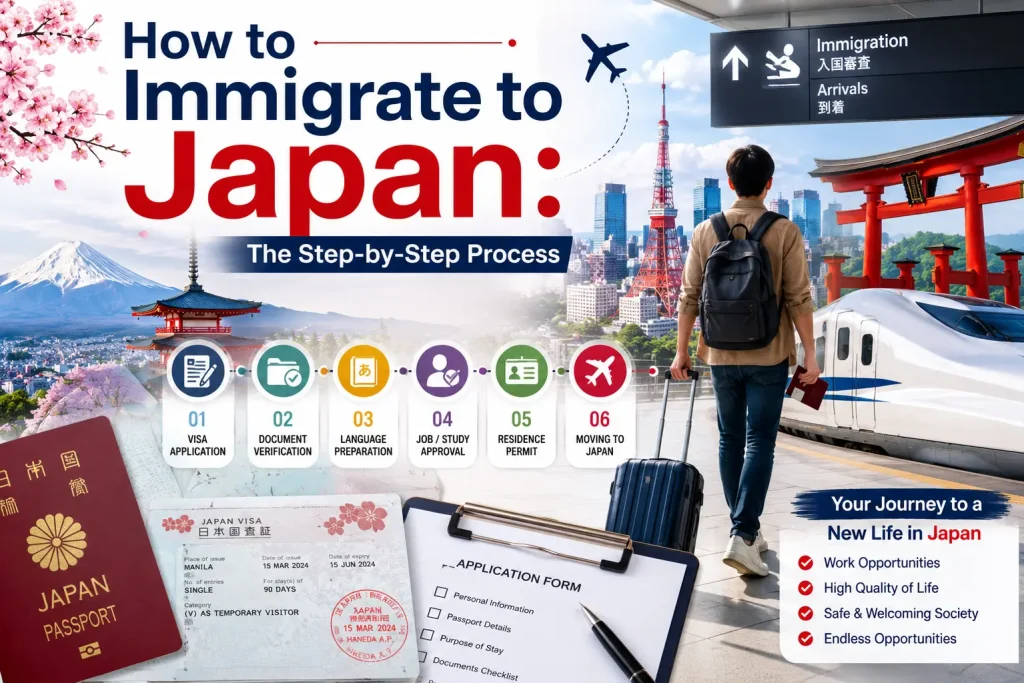
Understanding how to immigrate to Japan means knowing the full pipeline from initial application to arriving with your residence card in hand. Here is the process laid out clearly.
Step 1: Secure Your Sponsor or Admission
For work visas, your Japanese employer files the Certificate of Eligibility (COE) application with the Immigration Services Agency in Japan. For student visas, your school does this. The COE is the document that proves you meet Japanese immigration requirements for your visa category. You cannot apply for most long-term visas without it.
Step 2: Wait for Certificate of Eligibility Processing
The official processing time for a COE is one to three months, but it can take longer in some cases. Do not book flights or give notice at your current job until you have the COE in hand. The timeline can vary significantly depending on your visa type, the immigration office handling your application, and seasonal demand.
Step 3: Apply at Your Local Japanese Embassy or Consulate
Once you have your COE, take it along with your passport, the completed visa application form, a passport photo, and any required supporting documents to the nearest Japanese Embassy or Consulate in your home country. The consulate processing time is usually one to two weeks.
Step 4: Arrive in Japan and Collect Your Residence Card
When you land at a major port of entry, you will receive your Residence Card (Zairyu Card) at the airport immigration desk. This card is your primary form of ID in Japan. Keep it with you at all times, as police and local officials may request to see it.
Step 5: Register at Your Local Municipal Office
Within 14 days of moving into your address in Japan, you must register at your local ward or municipal office. This is called Juki-net registration. You will receive your My Number (social security number equivalent), which you will need for healthcare enrollment, banking, and tax filing.
Step 6: Enroll in National Health Insurance
All residents of Japan, including foreigners, are required to enroll in either the company health insurance scheme through their employer or the National Health Insurance (Kokumin Kenkou Hoken) program if they are self-employed or not covered by a company plan. Premiums are income-based, and the insurance covers approximately 70 percent of standard medical costs.
Documents You Need to Move to Japan
Preparing your documentation well in advance saves significant stress. Here is what most long-term visa applicants will need:
- Valid passport with at least six months of remaining validity beyond your intended stay
- Certificate of Eligibility (filed by your employer or school in Japan)
- Completed visa application form from the Japanese Embassy or Consulate
- One passport-sized photo (4.5 cm x 4.5 cm, white background, taken within the last six months)
- Academic transcripts and degree certificate, often with certified translations into Japanese
- Employment contract or offer letter from your Japanese employer
- Proof of financial stability (bank statements for the most recent three to six months)
- Curriculum vitae or resume in both English and Japanese
- Criminal background check from your home country (some visa categories require this)
If your country is not a member of the Hague Apostille Convention, your documents will need to be notarized and authenticated through the Japanese Embassy. Start this process early because it can take weeks.
Cost of Living in Japan: What to Budget For
Japan is often assumed to be expensive, but the reality is more nuanced. Major cities like Tokyo and Osaka carry higher costs, while mid-size cities like Fukuoka, Sendai, or Hiroshima offer notably lower expenses with still excellent quality of life.
Monthly Living Cost Estimates (Tokyo vs Regional Cities)
| Expense | Tokyo | Regional City (e.g. Fukuoka) |
| 1-bedroom apartment (city centre) | JPY 80,000-150,000/mo | JPY 45,000-80,000/mo |
| Groceries | JPY 30,000-50,000/mo | JPY 25,000-40,000/mo |
| Public transport | JPY 10,000-15,000/mo | JPY 5,000-10,000/mo |
| Utilities (electricity, water, gas) | JPY 15,000-25,000/mo | JPY 12,000-20,000/mo |
| Eating out (per meal) | JPY 800-3,000 | JPY 600-2,500 |
| Health insurance (national plan) | Income-based | Income-based |
Move-In Costs You May Not Expect
Renting in Japan involves upfront costs that surprise most newcomers. Beyond your first month’s rent you typically pay:
- Shikikin (security deposit): one to two months’ rent
- Reikin (key money or ‘gift money’): one to two months’ rent paid to the landlord as a non-refundable courtesy payment
- Agency fee: typically one month’s rent
- Guarantor company fee: around 0.5 to one month’s rent if you use a guarantor service
This means moving into a JPY 100,000 per month apartment in Tokyo can require JPY 400,000 to JPY 600,000 upfront before utilities or furniture. Budget accordingly.
Finding Housing in Japan as a Foreigner
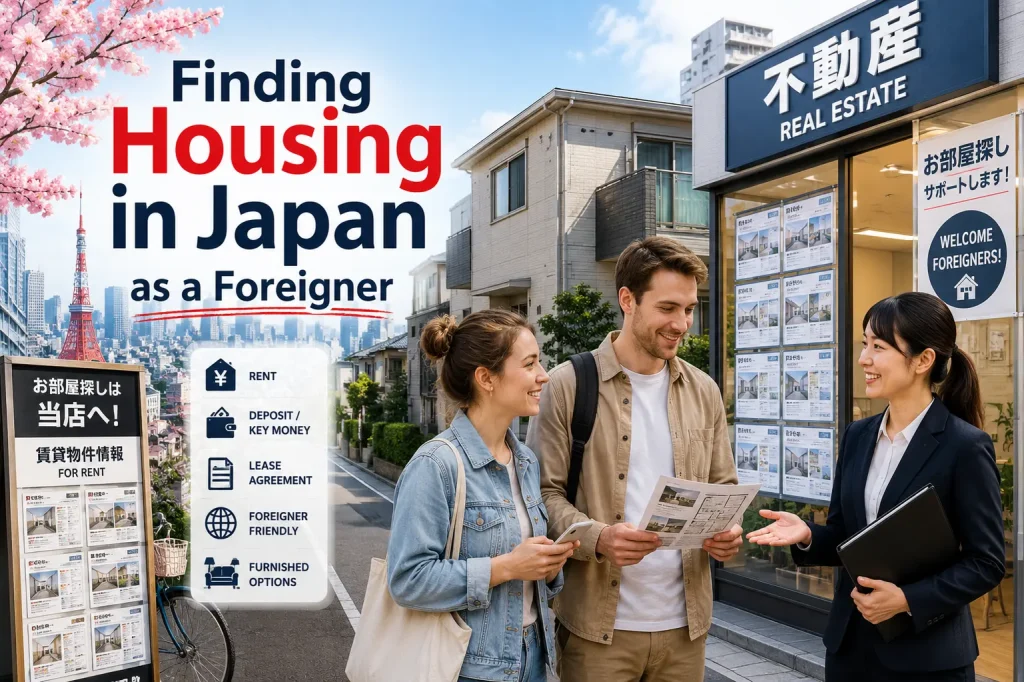
Housing is one of the most challenging parts of relocating to Japan as a foreigner. Many private landlords historically preferred Japanese tenants, though this is changing gradually, especially in urban areas with growing international populations.
How to Find Foreigner-Friendly Apartments
- Use platforms like SUUMO, Homes.co.jp, or GaijinPot Housing, which specifically list foreigner-friendly properties
- Contact English-speaking real estate agencies in major cities such as Sakura House, Leo Palace 21, or Fontana
- Ask your employer’s HR department about company housing (shacho jutaku), which many larger firms offer at subsidized rates
- Consider short-term serviced apartments or share houses for the first one to three months while you search for permanent accommodation
The Guarantor Requirement
Most landlords in Japan require a guarantor (hoshounin), historically a Japanese national who agrees to cover your rent if you default. Since most newcomers do not have a Japanese guarantor, the modern solution is to use a professional guarantor company. Your employer or real estate agent can often recommend one. Fees are typically 0.5 to one month’s rent upfront plus an annual renewal fee.
What Your Apartment Will Not Come With
Unlike many Western countries, Japanese apartments are typically rented in shell condition. This means no furniture, no light fixtures, no curtains, and often no appliances including refrigerator, washing machine, or air conditioning unit. Budget for these purchases on top of your move-in costs.
Japan Work Visa: Working in Japan as an Expat
Japan’s job market for foreigners has evolved significantly over the past decade. The tech sector, education, finance, and international business all actively recruit non-Japanese professionals. Here is what you need to know about working in Japan.
Finding a Job Before You Move
Most work visas require you to have a job offer before applying, so your job search begins before you leave your home country. Strong resources include:
- GaijinPot Jobs and Daijob for English-language job listings targeting foreign professionals
- LinkedIn with Japan-specific filters and Japanese language settings
- Industry-specific recruitment agencies such as Robert Half, Michael Page, and Hays Japan
- JETRO (Japan External Trade Organization) for those interested in business or government-adjacent roles
English Teaching as an Entry Point
English teaching remains one of the most accessible routes into Japan for native and near-native English speakers. The JET Programme (Japan Exchange and Teaching Programme) is a government-sponsored route that places thousands of foreign graduates in Japanese schools each year. Private English conversation schools (eikaiwa) such as ECC, AEON, and Berlitz also hire year-round and often assist with visa sponsorship.
Teaching English does not require a Japanese language background, but basic Japanese significantly improves your day-to-day life and makes you a more competitive candidate for renewals and promotions.
Tax Obligations as a Foreign Worker in Japan
Japan operates a progressive income tax system at the national level with rates ranging from 5 percent on income below JPY 1.95 million to 45 percent on income above JPY 40 million. Local inhabitant tax (resident tax) adds approximately 10 percent on top of national income tax. New arrivals are usually exempt from inhabitant tax in their first calendar year.
Your employer will withhold income tax automatically in most cases. However, you are responsible for filing an annual tax return if you have additional income sources. Non-residents (those spending fewer than 183 days in Japan) are only taxed on Japan-sourced income. Permanent residents pay tax on worldwide income.
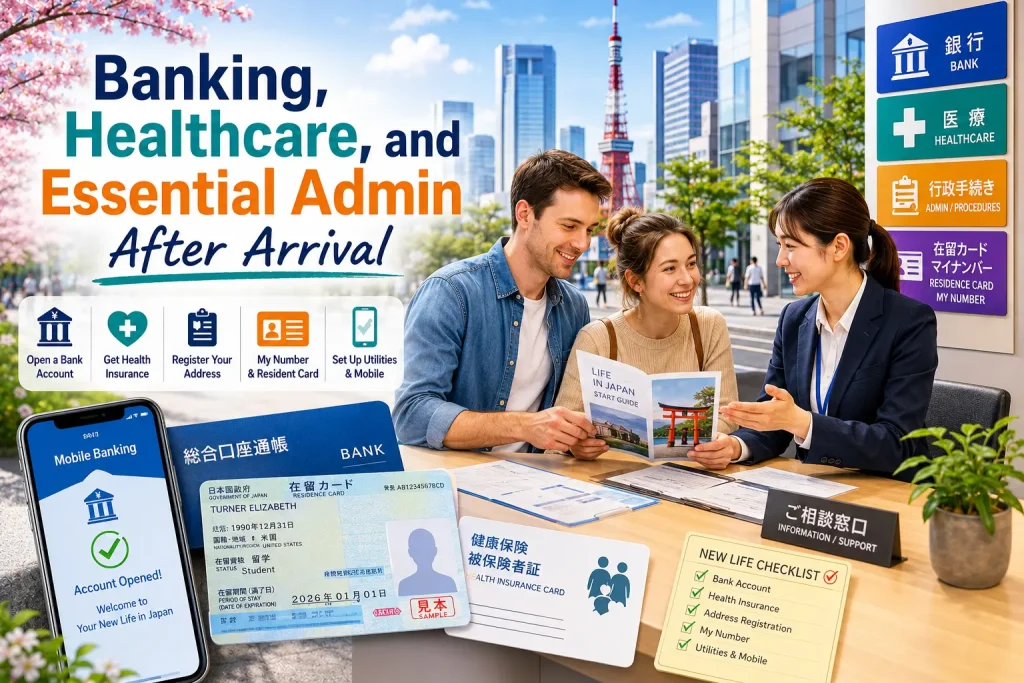
Banking, Healthcare, and Essential Admin After Arrival
Opening a Bank Account in Japan
Japanese banks have historically made it difficult for recent arrivals to open accounts. Most major banks including Japan Post Bank (Yucho), MUFG, and Sumitomo Mitsui require you to have been a resident for at least six months. Japan Post Bank is the most accessible for newcomers and accepts applications shortly after you register your address.
For immediate banking needs, international options like Wise or Revolut work well in Japan, and the Seven Bank ATM network (located in 7-Eleven convenience stores nationwide) accepts most international cards with low fees.
The National Health Insurance System
Japan’s universal healthcare system is genuinely excellent and accessible to all registered residents regardless of nationality. Once enrolled, you pay 30 percent of most medical costs out of pocket, with the insurance covering the remaining 70 percent. High-cost medical treatment caps (Kouhi Iryouhi) limit monthly out-of-pocket spending, providing financial protection against serious illness.
Company employees are enrolled in Shakai Hoken (social insurance), which also covers pension and unemployment insurance. Self-employed individuals and those not covered by employers join the National Health Insurance (Kokumin Kenkou Hoken) scheme through their local ward office.
The My Number System
Japan’s My Number is a twelve-digit social security and tax identification number assigned to every resident. You receive it by post a few weeks after registering your address at your local ward office. You will need your My Number for tax filing, healthcare enrollment, bank account applications, and various government services. Protect it carefully as it is used across sensitive administrative systems.
Cultural Adaptation: Living Well in Japan
Understanding Japanese culture is not just about politeness. It directly affects your ability to build professional relationships, navigate daily services, and feel genuinely settled rather than perpetually foreign.
Workplace Culture in Japan
Japanese work culture has a reputation for long hours and strong hierarchy, and while this varies significantly by company type and sector, some patterns are consistent. Decision-making often involves a process called nemawashi (building consensus before formal decisions) and ringi (formal document approval workflows). Understanding this helps you set expectations and avoid frustration when processes move more slowly than you are used to.
Many international companies operating in Japan and startups in Tokyo have adopted more Western management styles. If you are concerned about work-life balance, research company culture specifically rather than generalizing across all Japanese workplaces.
Social Etiquette Essentials
- Bowing is the primary greeting. A slight nod of the head works in casual contexts. Deeper bows for formal situations
- Remove your shoes when entering homes, traditional restaurants (with tatami seating), and some offices
- Business cards (meishi) are exchanged with both hands and treated with respect. Never write on them or stuff them in your pocket
- Speak quietly on public transport. Phone calls are generally avoided on trains and buses
- Queuing is taken seriously. Lines are orderly and cutting in is considered extremely rude
Learning Japanese: How Far Do You Need to Go?
In Tokyo and Osaka, you can manage daily life with English for most practical needs. Restaurant menus often have pictures or English translations. Major hospitals have interpreters. However, beyond the big cities, English availability drops sharply. Learning Japanese to conversational level transforms your experience from surviving to thriving.
Practical first steps include mastering hiragana and katakana (the two phonetic alphabets, each with 46 characters), which takes most people two to four weeks of consistent study. Apps like Anki for flashcards, LingoDeer for structured grammar, and HelloTalk for language exchange partners are widely used by expats.
Japan Permanent Residency: The Long-Term Path
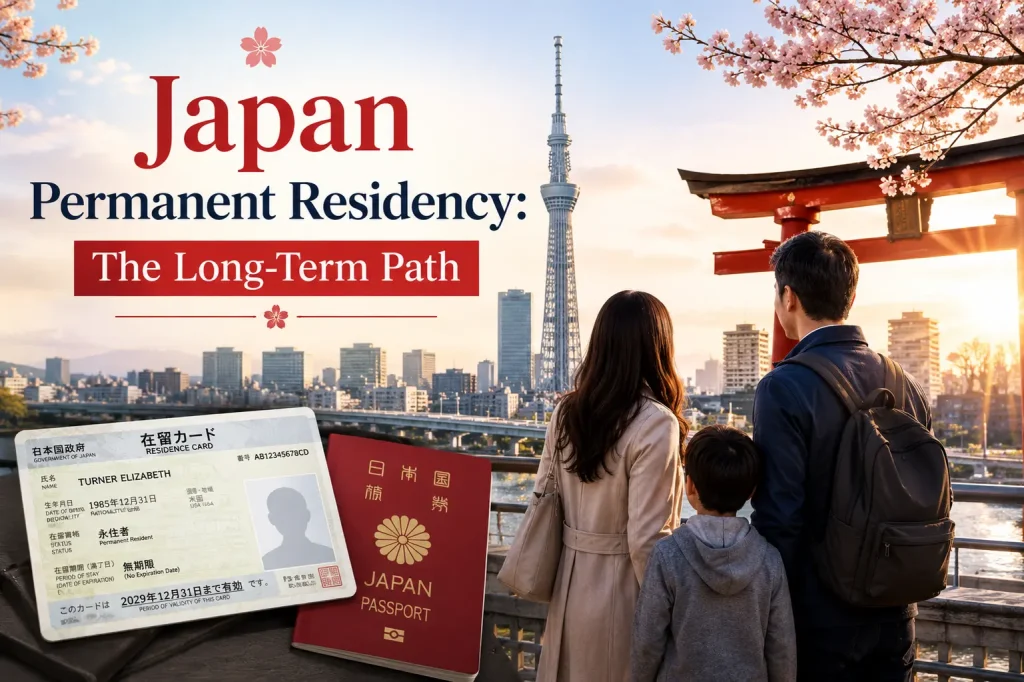
Japan permanent residency grants you the right to live and work in Japan indefinitely without renewing a category-specific visa. It is one of the most sought-after statuses for long-term expats because it removes most immigration restrictions on your professional and personal life.
Standard Permanent Residency Requirements
Under standard rules, you must have lived in Japan continuously for at least ten years, including a minimum of five years on a work or residence visa. You must demonstrate good behavior, financial stability, and payment of taxes and social insurance contributions throughout your stay. Your application is reviewed by the Ministry of Justice, and processing takes roughly six months to one year.
Fast-Track Routes to Japan Permanent Residency
Japan offers accelerated paths to permanent residency for certain categories of residents:
- Highly Skilled Professional (HSP) visa holders who score 80 or more points can apply after just one year of residence
- HSP holders with 70-79 points can apply after three years
- Spouses of Japanese nationals can apply after three years of continuous residence if also residing in Japan
- Long-term residents recognized by the Minister of Justice may apply after five years
Japan also reduced the standard residency requirement from ten years to five years for people who work in specific government-designated Future Creation Activity categories, which include certain research, business management, and investment roles.
What Permanent Residency Allows You to Do
- Work in any job or industry without employer sponsorship
- Start your own business freely
- Stay in Japan without renewing a visa category (though your residence card still needs updating every seven years)
- Bring eligible family members to Japan under dependent status
- Access the same employment rights as Japanese nationals in most sectors
The Path to Japanese Citizenship
Japan does not generally allow dual citizenship. To naturalize, you must renounce your original nationality. The standard requirements include five or more years of continuous residence (three years if married to a Japanese national), demonstrated Japanese language ability at roughly JLPT N3 level or above, and a clean legal record. Applications are filed through the Ministry of Justice and take one to two years to process.
Bringing Your Family to Japan
If you are moving to Japan with a spouse, partner, or children, the process involves additional visa steps for each family member.
Dependent Visas
Spouses and children of valid visa holders can apply for a Dependent visa (Kazoku Taizai). The main visa holder must demonstrate sufficient income to support the family, generally around JPY 3 million per year or more depending on family size. Dependent visa holders can apply for a work permit that allows them to work up to 28 hours per week.
Schooling for Children
Japan has an excellent public education system, and compulsory education is free for all resident children regardless of nationality. Public school instruction is almost entirely in Japanese, which can be challenging for children initially. Many expat families in major cities choose international schools, which charge tuition ranging from JPY 1 million to JPY 4 million per year depending on the institution.
Some municipalities offer Japanese language support classes for foreign children entering the public school system. Contact your local board of education (kyoiku iinkai) to ask about available support.
Practical Checklist: Before and After Your Move
Three to Six Months Before Moving
- Research and confirm your visa category based on your qualifications and purpose
- Secure a job offer or school admission in Japan if required for your visa
- Begin document preparation including certified translations and apostilles
- Open a savings account and begin building your move-in fund
- Start basic Japanese language study
- Research neighborhood options and housing platforms
One to Three Months Before Moving
- Confirm your employer or school has filed the COE application
- Arrange shipment or storage for your belongings
- Notify your current bank and set up international payment options
- Arrange accommodation for your first weeks (serviced apartment or share house)
- Research health insurance options and check if your employer provides coverage
Within the First Two Weeks of Arrival
- Collect your Residence Card at the airport
- Register your address at your local ward or municipal office within 14 days
- Receive your My Number notification
- Enroll in health insurance through your employer or local office
- Open a bank account at Japan Post Bank or a foreigner-friendly branch
- Get a Japanese SIM card or local phone plan
Conclusion
Learning how to move to Japan takes time and planning, but the effort is absolutely worth it. Japan offers a quality of life, cultural depth, and professional opportunity that few countries can match. The key is treating the process methodically: start with the right visa, prepare your documents early, understand the costs upfront, and give yourself time to adapt once you arrive.
Whether your goal is a one-year adventure, a stable long-term career, or eventually Japan permanent residency, the path is clear as long as you plan ahead. Japan rewards those who approach it seriously and with genuine respect for its culture and systems.
You May Also Like It:
Basic Coding Concepts – Beginners Guide
Simple Coding Projects for Beginners
Huffman Coding – The Core of Data Compression Explained
