
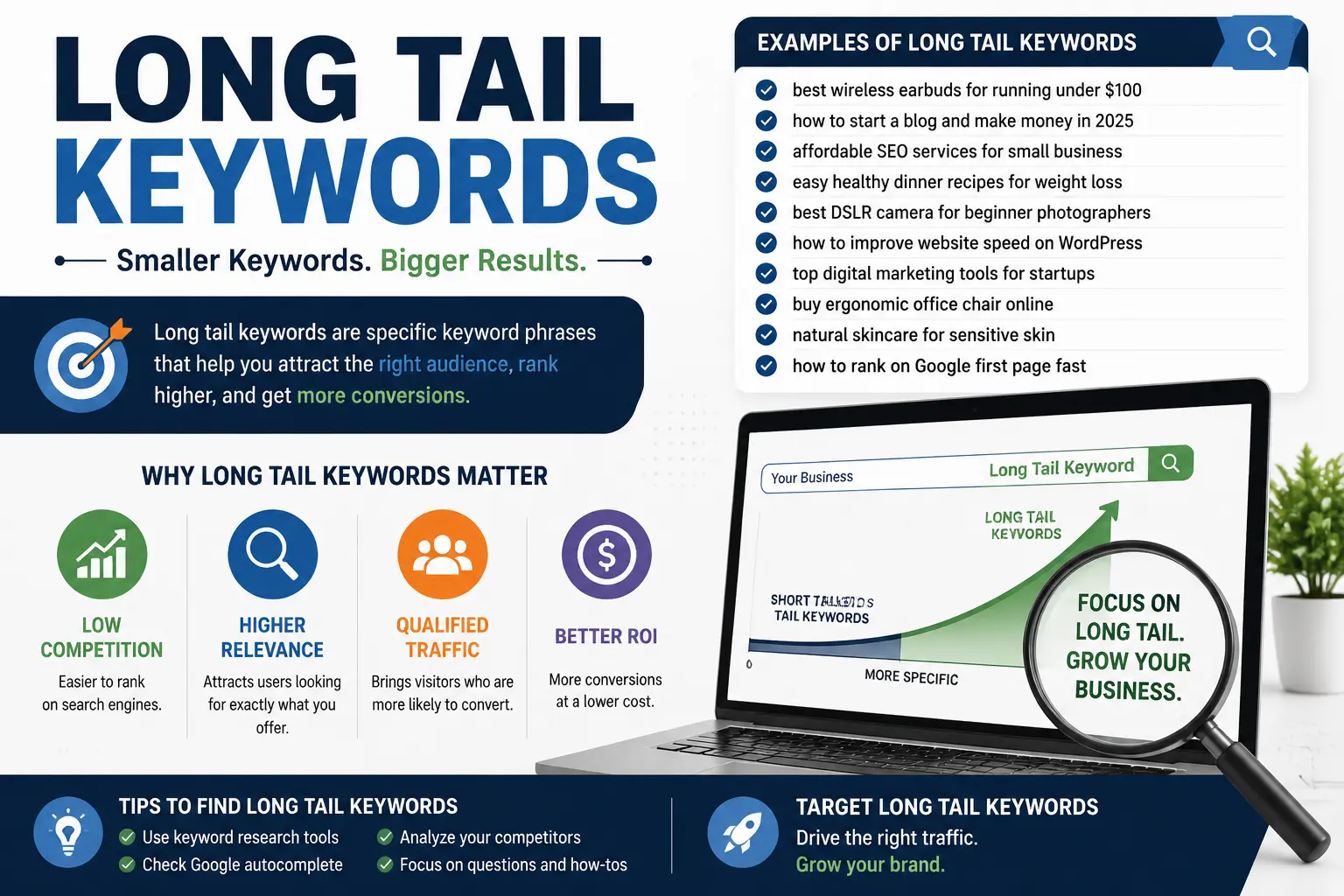
Long tail keywords are the reason a small website with no brand recognition can still outrank a household name in Google. While everyone fights over broad, one or two word searches, the specific, multi-word phrases people actually type make up the overwhelming majority of all search traffic. In fact, an analysis of 306 million keywords found that roughly 91.8 percent of all search queries qualify as long-tail keywords, not the short, generic terms most beginners obsess over.
This guide covers exactly what long-tail keywords are, walks through real long tail keywords examples across different industries, and lays out a practical, repeatable process for how to find long tail keywords for your own site, whether you run an ecommerce store, a local service business, or a content driven blog.
What Are Long-Tail Keywords?
A long-tail keyword is a highly specific search phrase that typically receives lower individual search volume than a broad “head” keyword, but reflects a much clearer intent from the person searching. The term comes from the shape of a search demand curve: if you plot every keyword people type into Google by how often it is searched, a small handful of broad terms sit at the tall “head” of the graph, while millions of longer, more specific phrases stretch out along a flattening “tail.”
A common misconception is that long-tail simply means a keyword with more words in it. Length is usually a byproduct, not the actual definition. What actually makes a keyword long-tail is specificity and intent. “Shoes” is a head term. “Best running shoes for flat feet” is long-tail, not because it has five words, but because it describes a specific product for a specific need. Most long-tail keywords fall somewhere between three and seven words, though voice search and AI chat queries can stretch well beyond ten words while still functioning the same way.
Long Tail Keywords vs Short Tail Keywords
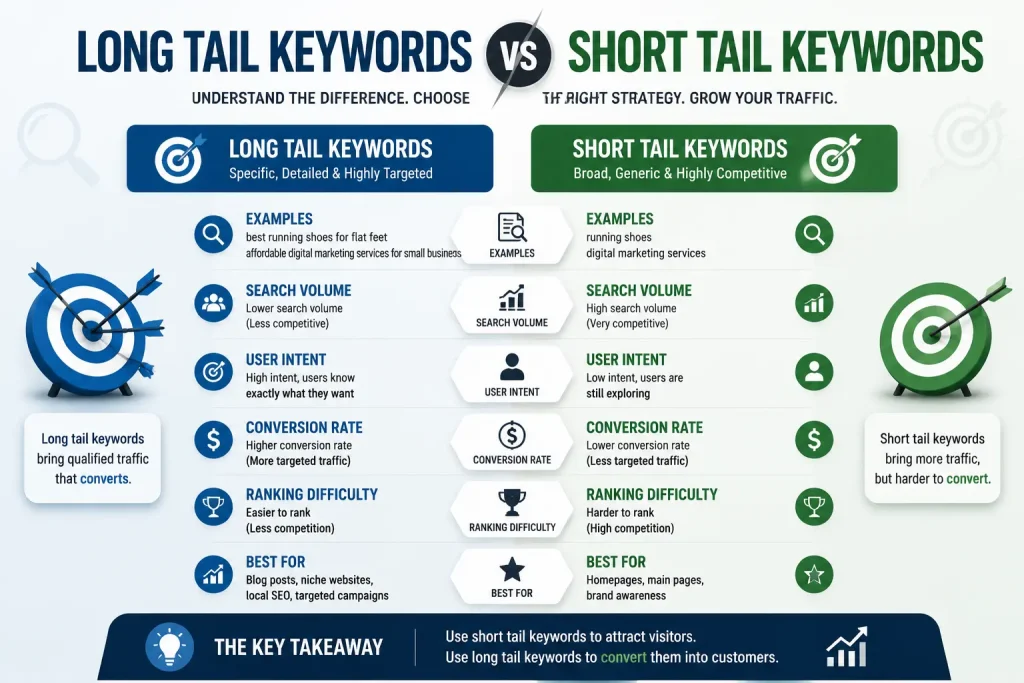
| Attribute | Short-Tail (Head) Keyword | Long-Tail Keyword |
|---|---|---|
| Example | shoes | best running shoes for flat feet |
| Search volume | Very high | Low to moderate |
| Competition | Extremely high | Low to moderate |
| Search intent | Broad, often informational | Specific, often transactional |
| Typical searcher stage | Early research | Close to a decision or purchase |
| Conversion rate | Lower | Higher |
| Content length needed | Often long and comprehensive | Can often be answered more directly |
What Are Long-Tail Keywords Used For?
Long-tail keywords show up across nearly every part of digital marketing, not just blog content:
- SEO content: Ranking for specific phrases is dramatically easier for new or smaller sites than competing directly on head terms.
- Paid search (PPC): Long-tail phrases usually carry a lower cost per click since fewer advertisers bid on them, while still converting well because the searcher’s intent is clearer.
- Voice search and AI assistants: When people talk to Siri, Alexa, or a chatbot instead of typing, they naturally phrase things as full questions, which is exactly how long-tail keywords read.
- Generative engine optimization: Tools like Google’s AI Overviews and AI chat assistants break a broad question into many smaller sub-queries to build an answer, a process sometimes called query fan-out. Content that directly answers a specific long-tail question has a better chance of being pulled into that answer.
Long Tail Keywords Examples
Seeing real long tail keywords examples side by side with their head term makes the concept concrete. Here are a few across different industries.
Coffee and food:
- Head term: coffee
- Long-tail: difference between Arabica and Robusta beans
- Long-tail: best grind size for a French press
Fitness and health:
- Head term: keto diet
- Long-tail: keto diet meal plan for beginners under 1500 calories
Local business:
- Head term: coffee shop
- Long-tail: organic coffee shop near me open after 9pm
Ecommerce:
- Head term: swim cap
- Long-tail: men’s blue swimming cap for long hair
Software and SaaS:
- Head term: CRM
- Long-tail: best CRM for a small real estate team under 10 users
Home and furniture:
- Head term: sofa
- Long-tail: elm wood veneer day bed with storage drawers
Notice the pattern across every example. The long-tail version tells you exactly who the product or content is for and exactly what problem it solves, which is precisely what makes it easier to rank for and more likely to convert.
How to Find Long Tail Keywords: A Step by Step Process
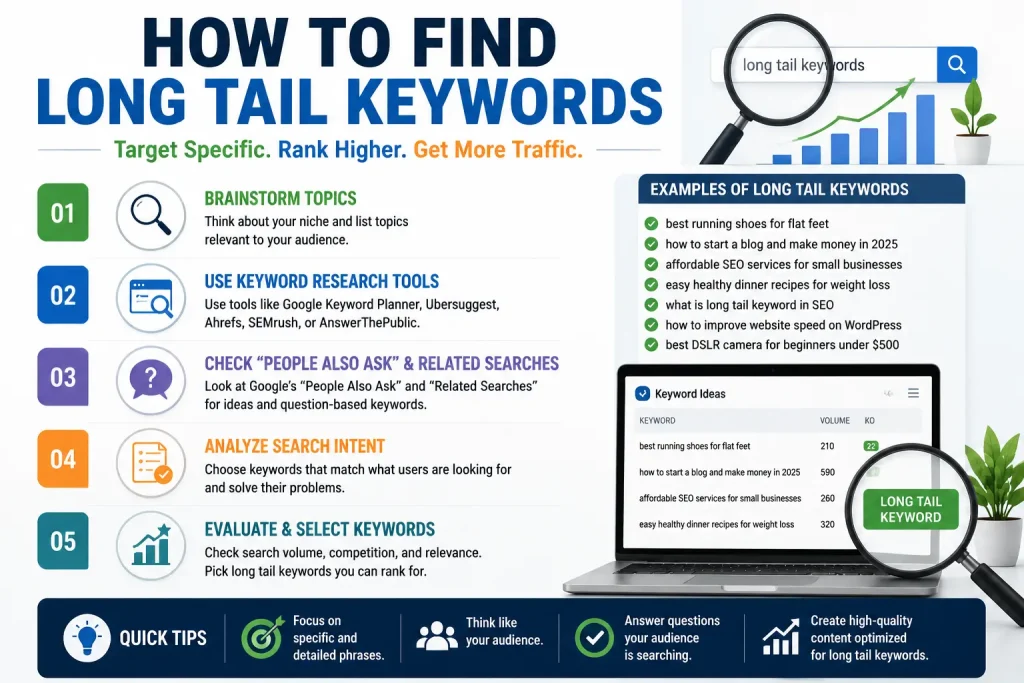
1. Start With Google Autocomplete
Type a broad seed term into Google’s search bar and pay attention to the suggestions that appear before you finish typing. These come directly from real searches and are one of the fastest, free ways to surface long-tail phrasing.
2. Mine the People Also Ask Box
Every relevant Google search now surfaces a People Also Ask box full of related questions. These questions are, by definition, long-tail keywords, since they reflect exactly how real users phrase their queries.
3. Check the Related Searches Section
Scroll to the bottom of any Google results page and you will find a “Searches related to” section, which often reveals long-tail variations you would not have thought to search for directly.
4. Use a Dedicated Keyword Research Tool
Free and paid tools such as Semrush’s Keyword Magic Tool, Ahrefs Keywords Explorer, Mangools KWFinder, and Ubersuggest let you enter a seed keyword and instantly generate hundreds or thousands of long-tail variations, often filtered by search volume, keyword difficulty, and cost per click.
5. Review Your Own Google Search Console Data
Sign in to Search Console, go to Performance, then Search Results, and scroll through the Queries table. You will frequently find that your site already ranks on page two or three for long-tail phrases you never deliberately targeted, which are often the easiest rankings to push onto page one.
6. Analyze Competitor Rankings
Run a competitor’s domain through a keyword research tool to see the long-tail phrases they already rank for. This is one of the fastest ways to find proven, demand backed long-tail opportunities without guessing.
7. Ask AI Chat Tools for Ideas
Asking an AI assistant to generate specific customer questions around your topic can surface natural, conversational long-tail phrasing that mirrors how people now search through voice assistants and AI chat interfaces.
8. Explore Online Communities
Forums, Reddit threads, and niche communities related to your industry are full of the exact phrasing real customers use when they are frustrated, confused, or ready to buy, which makes them a rich, often overlooked source of long-tail ideas.
Comparison of Popular Long-Tail Keyword Tools
| Tool | Free Option | Best For | Includes Search Volume | Includes Difficulty Score |
|---|---|---|---|---|
| Google Autocomplete | Yes | Quick, free idea generation | No | No |
| Google People Also Ask | Yes | Question based, conversational keywords | No | No |
| Semrush Keyword Magic Tool | Limited free searches | Large scale keyword databases | Yes | Yes |
| Ahrefs Keywords Explorer | Limited free searches | Competitor keyword analysis | Yes | Yes |
| Mangools KWFinder | Limited free searches | Beginner friendly long-tail discovery | Yes | Yes |
| Ubersuggest | Limited free searches | Budget friendly keyword ideas | Yes | Yes |
| AnswerThePublic | Limited free searches | Bulk question style long-tail phrases | No | No |
| Google Search Console | Yes, full access | Finding keywords you already rank for | Yes, via impressions and clicks | No |
Why Long-Tail Keywords Matter More in the AI Search Era
Search behavior has shifted noticeably toward longer, more conversational queries as people increasingly type or speak full questions into AI powered tools instead of short keyword fragments. Data from BrightEdge shows that queries triggering AI Overviews grew from an average of 3.1 words to 4.2 words within a single year, reflecting exactly this shift toward specificity. Because AI systems are built to answer a single, precise question rather than return a list of ten blue links, content that directly and clearly answers one specific long-tail question is far more likely to be surfaced or cited by an AI generated answer than a page written around a vague, broad topic.
This also reinforces the idea of topical authority. Ranking for one long-tail page rarely moves the needle alone, but publishing a cluster of long-tail content around every specific angle of a broader topic signals genuine expertise to both traditional search engines and AI systems, which improves rankings across the entire cluster, not just a single page.
Frequently Asked Questions
What are long-tail keywords?
Long-tail keywords are highly specific, usually multi-word search phrases that carry lower individual search volume than broad head terms but reflect much clearer searcher intent, which typically makes them easier to rank for and more likely to convert.
How do I find long tail keywords for my website?
Start with Google Autocomplete and the People Also Ask box for free options, then use a dedicated keyword research tool such as Semrush, Ahrefs, or Mangools to filter by search volume and difficulty, and review your own Google Search Console data to find long-tail terms you may already rank for without realizing it.
What are some long tail keywords examples?
Examples include “best running shoes for flat feet” instead of “shoes,” “keto diet meal plan for beginners under 1500 calories” instead of “keto diet,” and “organic coffee shop near me open after 9pm” instead of “coffee shop.” Each example narrows a broad head term down to a specific need or intent.
How many words does a long-tail keyword need to have?
There is no strict word count rule. Most long-tail keywords fall between three and seven words, but the defining factor is specificity and intent, not length. A four word phrase with vague intent is not automatically long-tail, while a highly specific three word phrase can be.
Are long-tail keywords still worth targeting in 2026?
Yes, arguably more than ever. As voice search and AI chat tools push search behavior toward longer, conversational queries, content built around specific long-tail questions is better positioned to be surfaced in AI generated answers, not just traditional search results.
Do long-tail keywords convert better than short-tail keywords?
Generally yes, since someone typing a highly specific phrase has usually already decided what they want and is closer to taking action, whether that is making a purchase, booking a service, or filling out a form, compared to someone typing a vague, broad term while still browsing.
Final Takeaway
Long-tail keywords are not a lesser version of SEO strategy, they are where the majority of real search behavior already lives. Instead of chasing a handful of broad, oversaturated head terms, build a repeatable process around Google Autocomplete, People Also Ask, dedicated keyword tools, and your own Search Console data to consistently uncover specific phrases your audience is already searching for. Publish content that answers those phrases directly, and you put yourself in position to win both traditional rankings and citations inside AI generated answers.
