
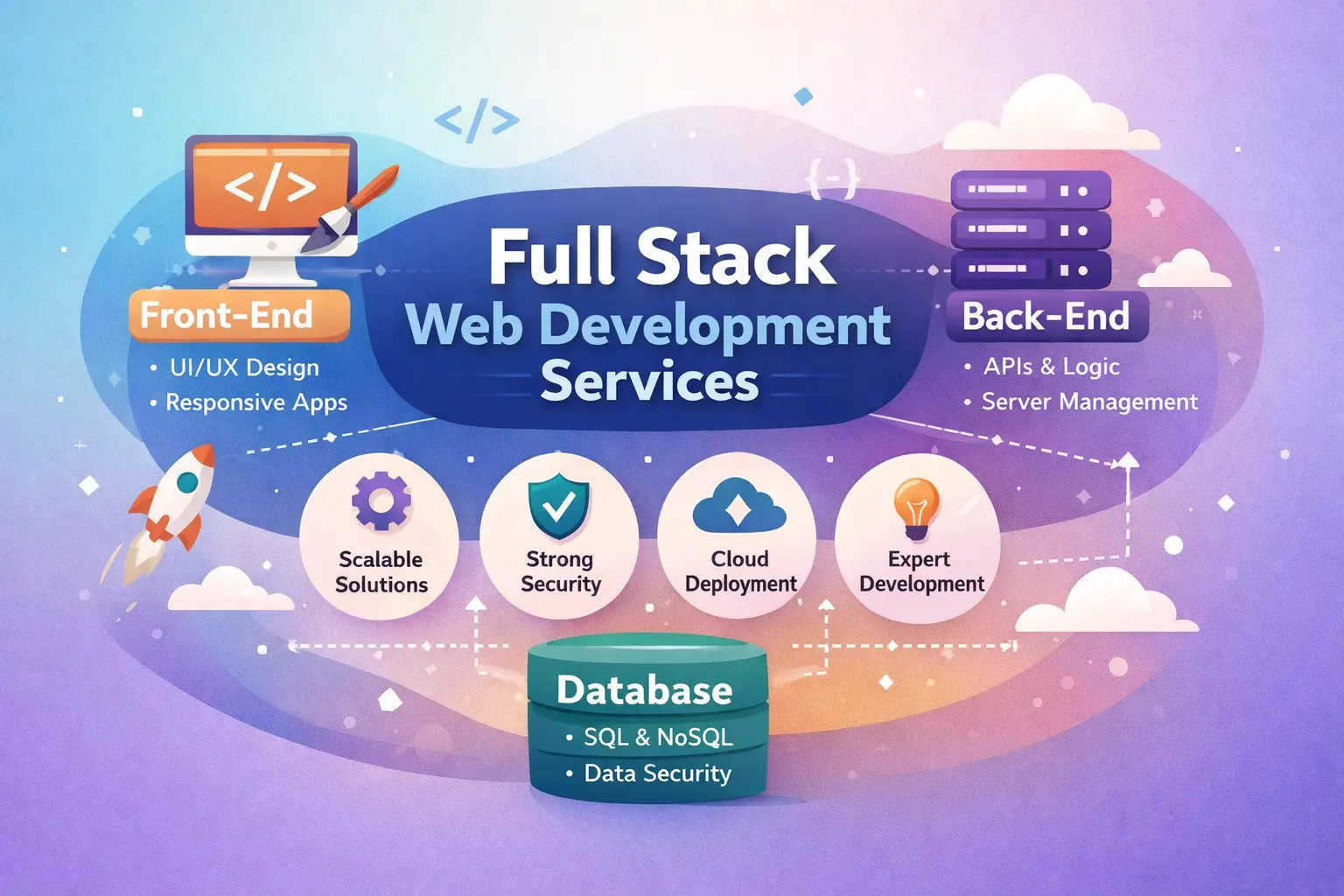
Full Stack Web Development Services: The Complete 2026 Guide
Modern businesses do not just need websites. They need scalable, secure, high-performing digital platforms that drive revenue, automate workflows, and create exceptional user experiences.
That is where full stack web development services come in.
In this complete guide, you will learn:
- What full stack web development really means
- What services are included
- Cost breakdown with real numbers
- Project timelines
- Technology stack comparisons
- ROI expectations
- Common mistakes to avoid
- How to choose the right development partner
This guide goes deeper than typical agency pages. It gives you practical insight you can actually use.
What Are Full Stack Web Development Services?
Full stack web development services cover both front-end and back-end development, along with database management, APIs, deployment, and ongoing maintenance.
A full stack development team handles everything required to build and maintain a web application.
The Three Core Layers of Full Stack Development
Front-End (Client Side)
- User interface (UI)
- User experience (UX)
- Responsive design
- Browser performance
Back-End (Server Side)
- Business logic
- Authentication systems
- APIs
- Server configuration
Database Layer
- Data storage
- Query optimization
- Security
- Backup systems
When these layers work together seamlessly, businesses achieve speed, scalability, and reliability.
What Is Included in Full Stack Web Development Services?
Many agencies simply say “end-to-end development.” But what does that actually include?
Here is a complete breakdown.
Front-End Development
Modern front-end development focuses on:
- React.js, Vue.js, Angular
- Responsive web design
- Progressive Web Apps (PWA)
- Performance optimization
- Accessibility compliance (WCAG standards)
A strong front-end ensures fast loading times and intuitive navigation.
Back-End Development
Back-end systems power your application’s logic and performance.
Common technologies include:
- Node.js
- Django
- Laravel
- .NET Core
- Ruby on Rails
Back-end development ensures:
- Secure authentication
- Scalable architecture
- API integrations
- Cloud deployment readiness
Database Design & Management
Choosing the right database is critical.
- Relational: MySQL, PostgreSQL
- NoSQL: MongoDB
- Hybrid models for complex systems
Your database impacts performance, cost, and scalability.
API Development & Integration
Full stack services include:
- RESTful APIs
- GraphQL APIs
- Payment gateway integration
- Third-party SaaS integration
- CRM integration
APIs connect your system with external tools.
DevOps & Cloud Deployment
Modern development includes automated deployment pipelines.
This involves:
- CI/CD setup
- Docker containerization
- Kubernetes orchestration
- AWS, Azure, or Google Cloud deployment
- Monitoring & logging
Without DevOps, scaling becomes difficult.
Why Businesses Choose Full Stack Web Development
Faster Development
A unified team reduces communication gaps.
Lower Costs
Hiring separate front-end and back-end teams increases overhead.
Better Accountability
One team owns the entire project lifecycle.
Consistent Architecture
Full stack developers design systems holistically.
Full Stack vs Separate Teams: Which Is Better?
| Feature | Full Stack Team | Separate Teams |
|---|---|---|
| Communication | Centralized | Fragmented |
| Cost | Lower | Higher |
| Speed | Faster iterations | Slower handoffs |
| Accountability | Unified ownership | Shared responsibility |
| Scalability Planning | Integrated | Often disconnected |
For startups and growth-stage companies, full stack teams typically deliver better ROI.
Full Stack Web Development Cost Breakdown (2026)
Most competitors avoid discussing pricing. Let’s break it down realistically.
MVP Development
- Cost: $15,000 – $60,000
- Timeline: 2–4 months
- Best for: Startups validating ideas
Mid-Level Business Application
- Cost: $50,000 – $120,000
- Timeline: 4–7 months
- Includes: Admin dashboards, APIs, cloud hosting
Enterprise-Level Platform
- Cost: $120,000 – $300,000+
- Timeline: 6–12 months
- Includes: Microservices, advanced security, AI integration
Ongoing Maintenance
- 15%–25% of development cost annually
- Covers updates, security patches, monitoring
Transparent pricing helps businesses plan strategically.
Typical Full Stack Development Timeline
- Discovery & Planning (2–3 weeks)
- UI/UX Design (2–4 weeks)
- Development Sprint Cycles (8–20 weeks)
- Testing & QA (2–4 weeks)
- Deployment & Optimization (1–2 weeks)
Agile methodologies allow flexible iterations.
Choosing the Right Technology Stack
Selecting the correct stack determines performance and future growth.
Popular Tech Stack Combinations
- MERN (MongoDB, Express, React, Node)
- MEAN (MongoDB, Express, Angular, Node)
- Django + React
- Laravel + Vue
- .NET + Angular
Your choice should depend on:
- Business model
- Traffic expectations
- Scalability needs
- Budget
- In-house technical expertise
ROI of Full Stack Web Development Services
Here is what businesses actually gain:
- Faster product launch
- Reduced technical debt
- Improved user retention
- Higher conversion rates
- Easier feature expansion
- Lower long-term maintenance costs
Companies that invest in scalable architecture save significantly on future rebuilds.
Common Mistakes Businesses Make
Avoid these costly errors:
- Choosing the cheapest vendor
- Ignoring scalability planning
- Skipping proper documentation
- Neglecting security testing
- Not budgeting for maintenance
Short-term savings often create long-term losses.
Security Across the Stack
Modern applications must include:
- SSL encryption
- Role-based access control (RBAC)
- API rate limiting
- Secure authentication (OAuth, JWT)
- Regular vulnerability scans
Security must be integrated from day one.
Industries That Benefit from Full Stack Development
- SaaS platforms
- E-commerce businesses
- Healthcare systems
- FinTech platforms
- Logistics & supply chain
- Educational technology
- Real estate platforms
Each industry requires custom workflows and secure infrastructure.
When Should You Invest in Full Stack Web Development Services?
You should consider full stack services if:
- You are launching a startup
- Your current system is outdated
- You need scalable cloud infrastructure
- Your application lacks performance
- You want unified development ownership
If your platform directly impacts revenue, investing in full stack development is strategic.
How to Choose the Right Full Stack Development Company
Look for:
- Proven portfolio
- Transparent pricing
- Clear communication process
- Technology expertise
- Post-launch support
- Strong documentation practices
Ask about their architecture planning process before signing any contract.
The Human Side of Full Stack Development
Behind every web application is a business goal.
Maybe you are:
- A founder trying to secure funding
- A CTO modernizing legacy systems
- A business owner scaling operations
Full stack web development services are not just about code. They are about building systems that support your growth, reduce risk, and create long-term digital assets.
The right team does not just develop software. They become strategic partners in your success.
Final Thoughts
Full stack web development services provide an integrated approach to building modern web applications.
They combine:
- Front-end excellence
- Back-end reliability
- Database optimization
- Cloud scalability
- Security best practices
When executed properly, full stack development delivers faster launches, better ROI, and scalable infrastructure ready for future growth.
If your goal is to build a high-performing digital product that evolves with your business, investing in full stack web development services is not optional — it is essential.
